
IP News
AI Is Not Replacing Patent Attorneys. It Is Exposing Commodity Work and Forcing a Strategic Choice
•
12 min read
•Views 1,019
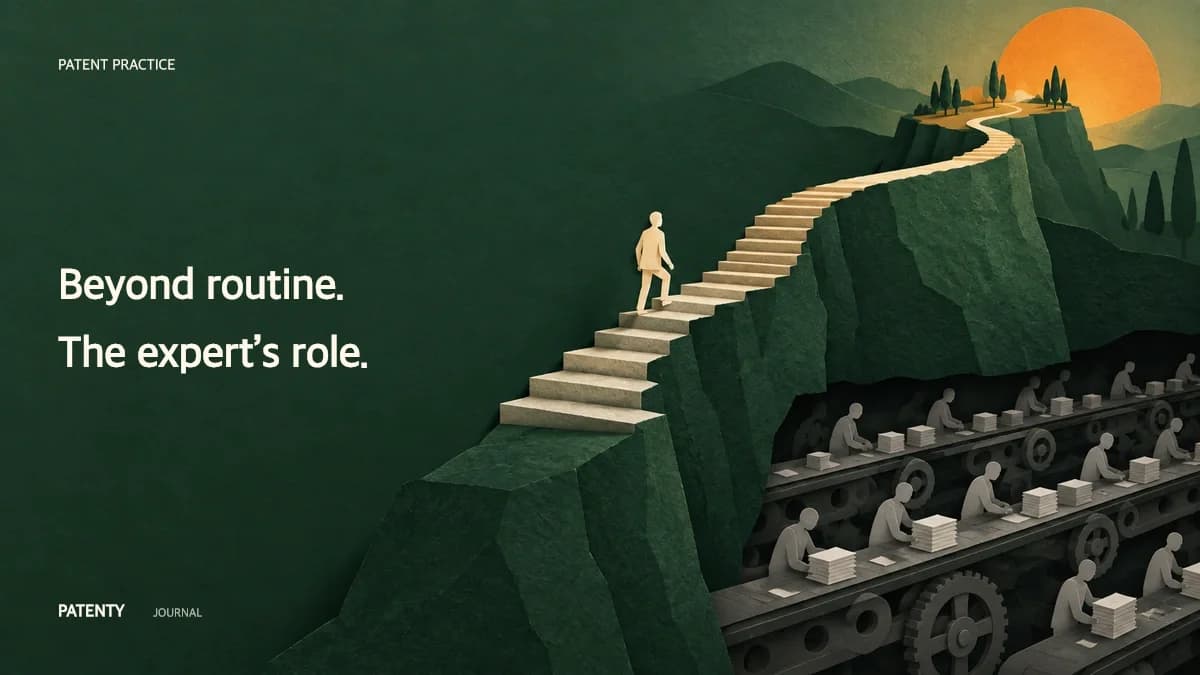
Artificial intelligence is compressing the time required for prior-art searching, claim comparison, and application drafting, but it will not replace experienced patent lawyers. Instead, according to Gene Quinn on IPWatchdog Unleashed on August 18, 2026, AI will expose practitioners whose output is primarily commodity production. The immediate strategic question for patent attorneys and corporate IP leaders is whether to deploy AI to reduce fees or to produce stronger, more commercially meaningful patent rights within existing budgets.
On August 18, 2026, IPWatchdog founder Gene Quinn published an analysis arguing that artificial intelligence is already transforming five core patent workflows: prior-art searching, claim comparison, application drafting, office-action responses, and portfolio analysis. Quinn stated that AI's greatest near-term value is its ability to move experienced patent professionals "from an 80% solution to a 95% solution in the same amount of time." He predicted that AI will not produce finished, file-ready work product soon, if ever, but will make experienced practitioners who embrace it "much better."
Quinn identified a specific risk: AI-generated language can sound technically and legally sophisticated while being fundamentally wrong. It may combine elements from separate embodiments that rely on incompatible operating conditions, propose implementations the inventor never conceived, or mischaracterize what a reference teaches. The analysis also warned that AI will disrupt the traditional apprenticeship model. Junior lawyers and patent agents historically learned judgment by conducting searches, reading references, drafting claims, and watching senior practitioners revise their work. If AI performs that entry-level work, younger professionals may become proficient at editing AI output without learning to recognize when it is incomplete, unsupported, or strategically irrelevant.
Quinn's analysis arrives amid a broader industry reckoning. In a May 26, 2026 IPWatchdog Unleashed panel, patent attorney John Rogitz emphasized that "the real value is in the enhanced quality that AI provides," not merely cost savings. Robert Plotkin described a "jagged frontier" of AI capability: tasks where AI excels sit directly beside tasks where it fails unpredictably. Carlo Cotrone warned that firms waiting passively for clients to define AI engagement rules risk a "death spiral" of fee compression.
Separately, on the same day as Quinn's analysis, AuriQ Systems Inc. announced the beta launch of Patent Analysis AI, a platform offering semantic prior art discovery, claim charting, prosecution-history analysis, and structured initial draft generation. The tool grounds every AI-generated analytical response in USPTO file wrapper history data and includes verifiable citations. Its existence underscores Quinn's point: the technology is real and deploying now, but it remains an assistive workspace, not a replacement for legal judgment.
The USPTO environment heightens the stakes. Quinn noted that the Federal Circuit, PTAB, and district courts are "routinely criticizing legacy patent quality." A patent system that increasingly demands more from applicants makes the quality-enhancement path the wiser choice for many filers. The alternative (using AI solely to reduce fees without quality improvement) produces patents that are cheaper to obtain but more vulnerable to post-grant challenge and litigation scrutiny.
The analysis presents a clear fork for patent practices. Firms that treat AI primarily as a discount engine will compete on price in a market where clients expect efficiency gains to translate into lower bills. Quinn warned that "requiring the human in the loop to spend less time is a strategy doomed to fail" in an industry where decision-makers are increasingly skeptical of patents. The alternative is to hold fees steady and use AI to deliver stronger claims, more thorough prior-art analysis, and better-reasoned responses to office actions.
For Korean corporate IP departments and law firms managing large portfolios before KIPO, the USPTO, and the EPO, the quality path has immediate operational meaning. A Korean firm prosecuting hundreds of applications annually can deploy AI to stress-test claim language against the USPTO's written description and enablement standards before filing, catching vulnerabilities that would otherwise surface only during examination or litigation. The concrete action is to run a controlled comparison: select ten pending applications, use an AI tool to generate a pre-filing claim critique or prior-art map, and measure whether the AI-assisted output identifies gaps the primary drafter missed. If it does, integrate that step into the standard workflow without reducing attorney review time.
The apprenticeship disruption carries a specific risk for Korean firms with hierarchical training structures. If junior practitioners stop conducting manual searches and drafting initial claim sets from scratch, they may never develop the judgment to recognize when AI output is technically impossible or strategically irrelevant. The corrective action is to require junior attorneys to annotate AI-generated drafts with explicit reasoning (identifying which limitations are supported by the specification, which embodiments are incompatible, and which claim scope decisions reflect commercial priorities) before a senior attorney reviews the work.
Quinn's observation that AI can "combine elements from separate embodiments that rely on incompatible operating conditions" is particularly relevant to Korean filers in the semiconductor, battery, and display sectors, where inventions often span multiple interdependent process conditions. An AI-generated claim that inadvertently mixes incompatible temperature ranges or material combinations from different embodiments creates a written-description vulnerability that may not surface until post-grant invalidation proceedings. Drafting attorneys should add a specific review step: for each independent claim, verify that every limitation combination appears in a single disclosed embodiment or that the specification provides explicit support for the combination.
The market will bifurcate. Firms that add strategic value (counseling on portfolio design, freedom-to-operate, and enforcement readiness) will use AI to deepen their advisory role. Firms that produce high-volume, low-complexity patents will face price pressure from clients who can increasingly generate first drafts internally using tools like AuriQ's platform. The panel's warning that "AI will expose which firms are genuinely strategic partners and which are merely labor providers" will play out over the next two to three examination cycles.
In the meantime, IP owners should audit their outside counsel relationships against one metric: does the firm use AI to reduce its own cost or to improve the work product? If the answer is unclear, request a specific explanation of how AI tools are deployed on your matters and what quality metrics are tracked. For in-house teams, the hedge is to build internal AI capability for prior-art searching and claim analysis while retaining outside counsel for strategic prosecution decisions and opinion work. This preserves the quality lever while insulating the organization from firms that treat AI as a margin-expansion tool rather than a quality tool.