
IP News
The $2.25 Billion mRNA Landmark: Analyzing the Moderna-Arbutus LNP Patent Settlement
•
5 min read
•Views 1,866
Updated:
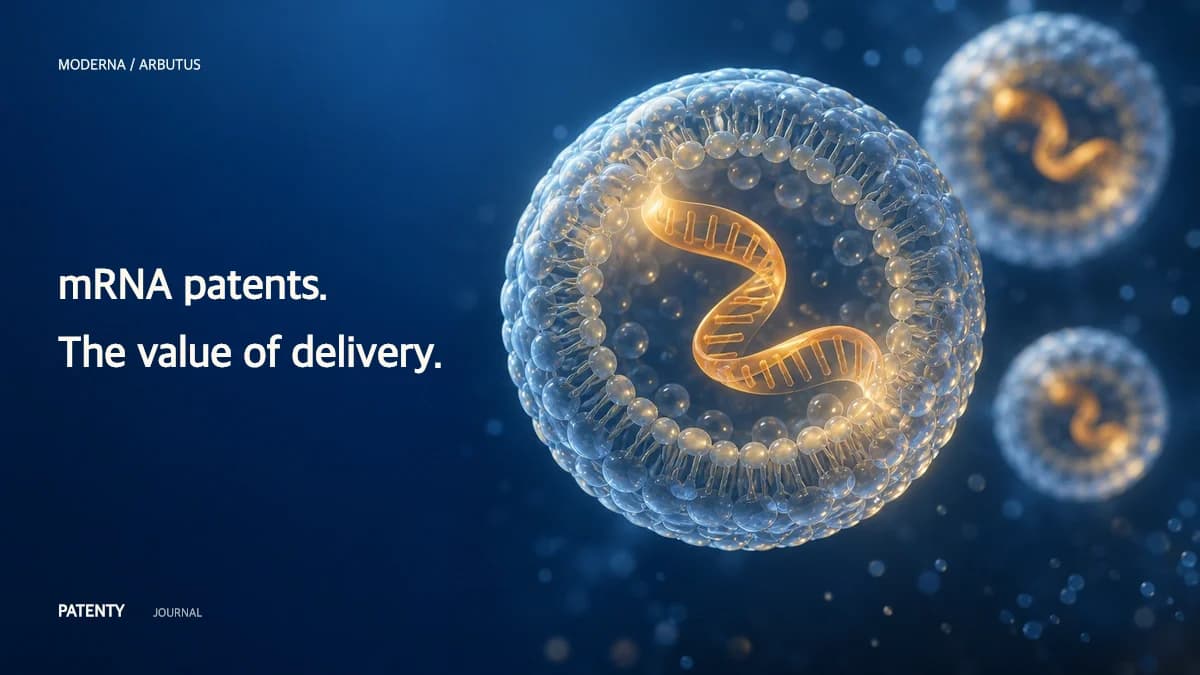
Moderna has reached a monumental $2.25 billion settlement with Arbutus Biopharma and Genevant Sciences, ending years of litigation over the Lipid Nanoparticle (LNP) technology used in its COVID-19 vaccine, Spikevax. This resolution represents one of the largest patent settlements in pharmaceutical history and highlights the immense strategic value of delivery-system IP in the mRNA era.
After a protracted legal battle spanning several jurisdictions and including multiple Inter Partes Review (IPR) proceedings, Moderna agreed to pay a total of $2.25 billion to Arbutus and its partner, Genevant Sciences. This is not a single lump sum: it comprises a $950 million upfront payment due in July 2026 and a further $1.3 billion contingent on the outcome of Moderna's appeal concerning Section 1498 (government use) of U.S. patent law. The dispute centered on foundational LNP patents, specifically those related to the microscopic fatty bubbles used to protect and deliver mRNA into human cells. Arbutus claimed that Moderna’s COVID-19 vaccine utilized its proprietary LNP technology without a license, while Moderna had previously attempted to invalidate these patents at the U.S. Patent and Trademark Office (USPTO) and the Court of Appeals for the Federal Circuit (CAFC), largely unsuccessfully.
Lipid Nanoparticles are not merely an additive; they are the essential "delivery vehicle" for mRNA therapeutics. While the mRNA sequence itself is often the focus of innovation, the delivery system has become a significant legal and commercial bottleneck. Arbutus Biopharma holds some of the earliest and strongest patent families in this space, stemming from research conducted at Protiva Biotherapeutics.
\n\n
\n
Moderna had spent years trying to clear the path by challenging Arbutus patents (such as the '069 and '435 patents). However, the CAFC's refusal to overturn the validity of these patents left Moderna in a vulnerable position as Spikevax generated tens of billions in revenue. The settlement covers not only past damages for the COVID-19 vaccine but likely includes licensing arrangements for future products, providing Moderna with the "Freedom to Operate" (FTO) it desperately needs for its pipeline of flu, RSV, and oncology treatments.
For Patent Attorneys: This case shows the danger of proceeding with commercialization when foundational "platform" patents remain valid. It reaffirms that even in national emergencies like a pandemic, intellectual property rights retain their massive economic leverage.
For IP Strategy: Companies developing mRNA-based drugs must prioritize delivery-system FTO as early as the pre-clinical stage. The $2.25 billion figure sets a staggering royalty benchmark for LNP technology, which will influence future licensing negotiations across the biotech sector.
Legal Operations: The sheer scale of this settlement may encourage other "platform holders" to pursue litigation more aggressively against late-stage pharmaceutical giants who have bypassed foundational IP.
In the world of high-stakes biotech, the delivery method is as valuable as the cure itself.
The resolution of this dispute removes a significant dark cloud over Moderna’s stock and future commercial activities. However, it also signals to the market that the "mRNA revolution" is built on an expensive foundation of licensed technology. We should watch for how this affects the pricing of future mRNA therapies and whether other mRNA players, such as Pfizer/BioNTech (who face similar LNP disputes with Arbutus/Genevant), will follow suit with similar blockbuster settlements.

IP Insights
Korea’s Madrid trademark filings rose 12.1% to 2,346 and Hague design filings 8.1% to 892 in 2024, while international design applications surged 16.8%, far outpacing patent growth. Yet most Korean IP practices remain patent-centric. This shift creates immediate inbound and outbound opportunities for firms that handle trademark and design prosecution, and a growing protection gap for those that don’t.

Market Intelligence
Nvidia’s $50 million investment in legal AI startup Legora signals a structural shift from model training to inference-heavy execution. This analysis explores how specialized compute architectures will reshape patent automation, prior art search, and the economics of intellectual property workflows.

Market Intelligence
Microsoft's introduction of the Legal Agent for Word marks a structural shift in legal and intellectual property technology. By embedding deterministic contract review and redlining capabilities directly into the enterprise document ecosystem, the launch challenges standalone AI vendors and accelerates the transition toward hybrid, context-aware workflow automation.